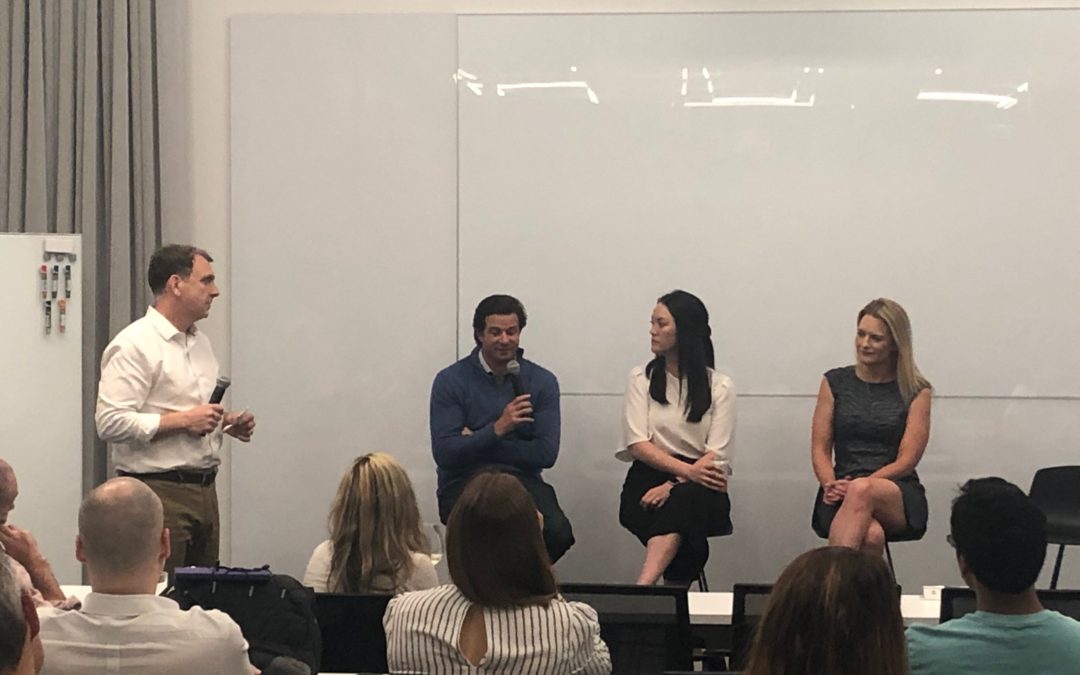
Last week Launchways collaborated with FinTex to host an educational panel which focused on the HR issues startups face as they scale. FinTex is a nonprofit organization which provides local Financial Technology (“fintech”) startups with the education and resources they need to be successful. Having identified HR issues as a top challenge area for the Chicago fintech community, FinTex enlisted Launchways to host an educational event on the topic.
Launchways is a Chicago-based provider of strategic solutions for Human Resources, Payroll, and Employee Benefits. Launchways specializes in working with growing companies to help them get the people part of the business right. As a member of the vibrant Chicago startup community themselves, Launchways was elated by the opportunity to partner with FinTex to support their mission of educating local fintech leaders.
Launchways assembled a panel of expert HR thought-leaders representing some of the fastest growing companies in the Chicago fintech space. Panelists included:
Ryan Pollock, Managing Partner, Objective Paradigm
Carolyn Kwon Montgomery, VP of People, Pangea Money
Carrie Gibson, Head of Talent Development Diversity & Inclusion, Avant
Launchways was also excited to welcome Jay Rudman, CEO, TopstepTrader, who gave the opening remarks at the event and is an active leader with the FinTex organization.
Launchways CEO, Jim Taylor, introduced the panelists and moderated the discussion throughout.
The topics covered during the panel included:
Recruiting: high-impact recruiting strategies and tips on how to create seamless hiring processes to build your team as you grow.
Retention: how to audit your company’s employee retention health and enact effective strategies that engage and retain your key employees.
Compensation/Equity: how to structure effective compensation packages and better understand how to reward and retain key employees with equity.
Both FinTex and Launchways extend their sincerest gratitude to Convene, who sponsored the event by providing the venue.
Let’s face it: it’s hard to replace great
executives in the growing business and startup worlds. No one wants to struggle
to constantly fill the same positions over and over again. It’s much better to
find great talent and keep it for a long time. However, given the competitive
market and the high demand, it’s hard to accomplish that in a sustainable,
timely manner.
What can employers, boards, stockholders, and
other invested parties do to reward and pay top executives to integrate them
more into the company and to have them stay with companies for the long term?
The answer is much trickier than most people would like to believe. It’s not as
simple as hiring high-performers in the first place, paying people more, or
even profit sharing. These are many different tools to help structure executive
compensation, but they are not the answer to your problem.
That answer is best discovered by a careful
evaluation of several factors. And the three main categories can be summed up
as follows.
Understanding the power and
limitations of money as a motivator
Assessing what your business can
and can’t do to boost executive compensation
Approaching executive compensation
as part of a multi-layered plan to reward real results
Money as a Motivator
The data shows that money does not always work as a motivator. For
people working low-paid jobs, money is definitely a motivator. They have bills
that need to be paid and a roof that they need to keep over their heads. But what
about for people building a career that have a track record as a high performer?
There is a similar need, but it may not be as urgent. In fact, if it is urgent,
those people will look elsewhere for other options.
The true difference between how much money
motivates low-wage workers and your executives should be that your executives
are (at least in theory) invested in your company.
Now that the theory is out of the way, the fact remains that money is still a force to be reckoned with at any stage of a great career. Money is the primary way most people meet their day-to-day needs and wants. If those are not met, no amount of extra perks or positive reinforcement will keep top talent at your company for the long term.
A great place to start when you are assessing
your executive compensation strategies is what the current executive salary for
the positions in question stand at today. This step is particularly important
for small businesses and startups. Larger companies may have resources and
certainly a larger network on which to draw this information from. They also
tend to factor salaried positions sooner simply because they have to deal with
it more.
Once you know how your baseline salary
compares to the competition, you can make a more informed decision about how to
proceed. Some ideas include but are not limited to:
Traditional bonuses
Traditional pay raises
Milestone bonuses
Gain sharing
Ad-hoc rewards/spot bonuses
And other forms of non-monetary
reward
These are all viable options depending on your company’s or startup’s situation.
However, they don’t mean much on their own without an understanding of what
your executives actually want and what your business can offer. Let’s take a
look.
Assessing
the State Of Your Business
At this stage, it may be helpful to compare
structuring your executive compensation plans to building a shed. Above, the
different materials that your plan can use have been laid out and the basic
purpose has been explained. But before a solid plan (or shed) can be
structured, you need to know what tools you are working with and not just the
materials you will use.
Two different situations must be treated in
this section. The first is when a company is beginning the process of bringing
on their first executive and arranging how he or she will be paid. The second
deals with revamping or reforming existing executive compensation plans.
Building Your Plan From the
Ground Up
Many successful small businesses and startups
find themselves faced with the challenge of hiring and paying executive leadership
at a time when they may not be ready for it. Some simple guidelines to keep in
mind include:
What the company can and can’t
afford
General expectations from your new
employee and from the company
How to tie the success of the
company to the success of your executive(s)
Simply put, if the money isn’t there at the
moment, it’s not there and it can’t be used. The expectations of your new
employee should be addressed in order to prevent miscommunication and
dissatisfaction. FInally, when the success of the company directly impacts the
success of your executive(s), they will be more motivated both for the sake of
the company and for the sake of their careers.
Restructuring Existing Plans
The other situation a small business in
particular may find themselves in is restructuring their existing methods in
order to bring the business to new heights or out of recent slumps. In this
case:
And discover how to tie the
success of the company to the success of your executive(s)
While most of the same points apply in this
situation as in the first, one particular point deserves a mention. Existing
structures should be torn down at certain points, inconvenient as it may be for
the rest of the company. This is especially true when the current situation has
not contributed to the growth of the company.
In Either Case
Assessing what your business can and can’t
offer should happen on a regular basis, regardless. When it comes to things
such as salaries, bonuses and compensation plans in general, those numbers are
very informative and valuable. For significant changes, a clear understanding
of where your business is at and where you want to go is priceless.
Creating Your Executive
Compensation Plan
With the groundwork in place, creating your
executive compensation plan should be a much easier process. Given the fact
that each situation by nature is fairly different, it’s hard to say
specifically how you should move forward from this point on.
However, the basics of a compensation plan are
the same no matter what:
Base salary
Bonuses of all sorts
Benefits
Long-term incentives
And perquisites
When Increasing the Money is Not
an Option
Compensation is not always about increasing
bonuses or salaries. Consider alternative ways of rewarding results, such as
additional vacation days under the same salary or flexible working hours when
appropriate. With a little extra effort, these options can be built into your
plan at a very small additional cost to your company.
Key Takeaways
The top executive talent out there has options
and they aren’t afraid of using them to their own advantage. When small
companies and startups can collaborate with their executives and reward real
results, it’s beneficial to everyone.
Whether you are part of a small business or a
rapidly-expanding startup, the basics of structuring your executive
compensation plan remain the same:
Money motivates people to an extent,
especially when it meets their needs. When it unexpectedly goes above and
beyond, it can be extremely motivating.
Your overall strategy should be
based on the state of your business, not on “what people say” or other outside
statistics. You know best what you can give and should communicate that to your
executives.
Real results should be rewarded in
a way that’s directly tied to the success of the business.
A unique executive compensation plan built on
these three points is a great start to success.
In conclusion, structuring your executive compensation plan to reward and promote results is a fundamental cornerstone of successful small businesses or startups. And when that is accomplished, it creates a firm foundation for your business’ growth.
Are you looking to hire an employee benefits broker and
don’t know where to start? Or have you had the same broker for a while and are
now wondering whether you could do better? Picking the right benefits broker is
challenging, especially because the right partner can have an enormous impact
on your employees and your bottom-line.
You want to work with a company that is not just your
benefits broker, but your trusted benefits advisor. Especially at growing
companies, having expert third-party help is essential to keeping your costs
low and your value-add for employees high. The right benefits broker will not
just sell you on a benefits package and then leave you to figure out the rest.
They will be an HR and Benefits specialist who can help you navigate the entire
benefits process and keep your benefit offerings up-to-date and competitive.
But the stakes are high, and there’s so much to consider –
how do you even get started? Well, luckily this guide is here to help you. We
will examine why it’s important to pick the right broker, and when to hire a
new broker before diving into what you should be looking for in a broker,
including that they provide:
Modern benefits that appeal to your workforce
Cutting-edge benefits technology
Cost savings
Comprehensive employee education
Looking for a Better Benefits Broker: Why and When to Start
Before we dive into what you should be looking for in a
benefits broker, let’s examine the reasons why it is important to choose the
right broker and when to start looking for a better partner.
Why You Should be Picky About Your Benefits Broker
Your benefits broker’s performance will have an enormous
impact on your benefits package’s ability to draw top talent to your company,
encourage your existing employees to deliver their best work, and keep
employees around for the long-haul. These are just some of the reasons why it’s
important to pick the right benefits broker, but let’s look at some specifics.
On a purely numbers level, benefits are a big deal. Benefits
spend is a large part of your overall budget, making up 25-40% of most
companies’ payroll. The right partner will help you minimize those expenses
while maximizing the return-on-investment.
But benefits are never all about numbers; they are
ultimately about people. Your benefits package is one of the most important
parts of your employees’ total compensation package and is meant to help your employees
live a higher quality of life. Your benefits broker should help you craft a
package that meets those needs for the well-being of your employees and your
company. Benefits that are tailored to take care of your employees will
strengthen your company culture and can mean the difference between attracting
and retaining top talent that drives your company’s growth or watching your
best people leave for better offers. Your employees are responsible for your
company’s success, so it’s important to make sure that they are properly taken
care of.
So, when building or updating your benefits package, you
need a benefits broker who will help you balance your budget and your
employee’s needs. Which is why it is important to be choosy when hiring a benefits
broker, and not just stay with the same broker because that’s what you’ve done
in the past. But when is the right time to make a change?
When to Shop for a New Employee Benefits Broker
Many companies overlook the importance of taking a proactive
approach to benefits, frequently staying with the same benefits broker for
years out of habit. That means that employers fall out of touch with the newest
benefits trends, losing the ability to properly evaluate whether or not their
current broker is providing them with the best possible service. That’s
why it’s a good idea to keep yourself apprised of what’s what in the benefits
world so that you can tell when your benefits broker may be underserving your
business.
The decision of what kind of benefits broker you are looking
for, and whether your current broker meets that description, should be based on
a comprehensive review of your company’s mission/vision, culture, short and
long-term goals, and business strategy. You want a benefits broker that will
support each of those elements and help you achieve sustainable growth.
So, the reasons why you may want to look for a new benefits
broker will depend on your unique business needs. That being said, there are
some clear signs that it’s time for a new broker that any business can look out
for, including:
Continuing to pay the same fees while retaining more or less the same benefits package year-over-year
Receiving limited guidance and/or a poor service level from the broker
Going several years without reexamining the broker relationship
Difficulty finding ROI to justify investment in your current broker
Your business and its needs are constantly changing and so
is the benefits marketplace. If you haven’t updated your benefits offering in
quite some time, chances are that you can do better for your employees and your
bottom line by looking for a new benefits partner.
How to Pick the Right Employee Benefits Broker
Now you know why you should take a proactive approach to
your relationship with your benefits broker and what to look out for when
deciding whether or not to look for a new broker. But how do you know which
benefits broker is right for you, once you’ve decided that your current one
isn’t meeting your needs?
Modern Benefits
The last thing you want is a broker who doesn’t stick with
the times and strive to deliver cutting-edge, high-impact benefits options.
Looking for a broker who can craft modern benefits packages will not only help
you compete in today’s market, and offer benefits that even appeal to
Millennial talent, it will also help you find a broker that you can trust long-term.
If a broker is keeping up with the latest and greatest now, odds are that they
will continue to do so. On the other hand, ff they’re already behind the times,
chances are they’ll just continue to fall behind.
What kind of benefits should the ideal broker help you
navigate? Some hot-topic benefits to ask about are telemedicine, financial wellness,
remote work, and other flexible work benefits that will help you compete in the
digital age. Again, even if these benefits aren’t the right fit for your
company now, they might be in the future and a broker who has expertise in building
diverse benefits packages will likely offer other cutting-edge solutions that
you can use.
Another increasingly popular option that the ideal benefits
broker will be able to offer is wellness benefits. These benefits help prevent
lifestyle-related healthcare costs while increasing employee engagement and
quality-of-life. Think of subsidized gym memberships, weight-loss or
smoking-cessation challenges, access to a nutritionist, financial planning,
employee assistance programs, and more. There are so many wellness benefits
that it’s easy to get overwhelmed. The right broker will help you find the
benefits that address your employees’ specific challenges.
Benefits Technology
Technology is an all-too-often overlooked aspect of what sets
a great benefits brokers apart. Software is what makes the world run nowadays,
and benefits are no different.
Benefits technology makes navigating your benefits package
easier for your HR team and your employees. The ideal broker will offer a
benefits portal that makes reviewing and managing your benefits package in one
central location a breeze. This makes it easier for you to plan your benefits
strategy and for your employees to take full advantage of your offerings. It’s
perhaps even more important that your benefits broker provides you with
enrollment software to ease the annual headache that is open-enrollment.
Getting employees enrolled in benefits is one of the hardest parts of the job
as an HR professional, and a streamlined software solution can make open enrollment
as painless as possible for both your HR team and then rest of your employees.
Cost Savings
Of course, one of the main reasons to hire a benefits broker
is to minimize your benefits costs while maximizing your package’s impact on
your employees. That’s why it’s a good idea to hire a benefits broker who will
also serve as your benefits consultant or employee benefits advisor, helping
you craft a strategy that meets your goals and needs.
One of the main ways that brokers can help you develop your
benefits strategy is through data collection. They can provide third-party
health risk assessments (HRAs) and employee surveys to establish demonstrated
employee needs. That information enables you to craft a strategic benefits plan
that keeps costs low while increasing the benefits that matter most to your
employees.
Another cost-saving offering to look out for is a tiered
health plan structure. These health insurance packages allow employees to
manage their health expenses, keeping your costs low while making sure that
employees get the coverage they need. Young and healthy employees to take on
low-premium, high-deductible plans paired with HSAs to keep their upfront costs
low, while employees with families or health risks can opt-in to more
comprehensive plans.
Health savings don’t stop at the plan level, either. The
right benefits broker will help you reduce your prescription drug spend while
making sure that your employees get the medications they need. Drug formularies
can guide employees towards lower-cost, preapproved medications and away from
expensive alternatives. When necessary, benefits brokers can also help you
impose limited restrictions such as requiring employees to try generic drugs
before covering name-brand equivalents. And some brokers will help you cut
costs across the board by offering a prescription savings card as an added
benefit for your employees. These cards can help employees save up to 80% on most
medications.
Education
Your financial investment into your benefits strategy isn’t worth
a whole lot if your employees don’t understand the benefits offered to them.
Your benefits broker can help you provide your employees
with the tools they need to decrease their medical expenses and increase their
wellness to minimize days off and maximize productivity. But if your broker
doesn’t also help you educate your employees about those options then your
employees won’t take advantage of them. As a result, you won’t see those
savings that the broker promised when you when you hired them.
Even by itself, education has a huge impact on your bottom
line and employee welfare. According to a McKinsey survey, engaged healthcare
consumers spend one-third as much as passive consumers. That means that having
a benefits broker who helps you educate and engage your employees can lead to
massive savings for your employees and your company. Plus, helping your employees
become educated, intelligent benefits consumers will allow them to better understand
their own needs.
At the same time, you’re investing a huge amount of money
into employee benefits to reward and engage your employees so that they are
productive, loyal, long-term members of your team. You want to make sure that
they understand all of the benefits that you are offering them and all of the perks
that make your benefits package stand out.
Choosing the Right Employee Benefits Broker: Key Takeaways
We’ve covered a lot in this guide, so let’s take a moment to
go over the key points that you should keep in mind when hiring a benefits
broker:
Benefits are a major expense and a significant investment in your human capital, so it’s important to work with the right broker for your organization
Don’t simply stay with the same benefits broker for years without reexamining the relationship, and be on the lookout for signs that your broker isn’t keeping up with the latest benefits trends
Look for a broker who offers and has expertise in modern benefits such as telemedicine and wellness benefits
Ensure your broker offers software solutions for benefits management and enrollment
See what the benefits broker can do to help you build a benefits strategy and proactively manage your benefits costs
Work with brokers who will help you educate your employees so that they can take advantage of their benefits, fully appreciate the package you offer, and become smarter healthcare consumers
As a CFO, your job isn’t easy even at the best of times.
You’re responsible for managing the company’s financial health, capital
investments, and return on those investments. And as if that wasn’t enough, many
modern CFOs have now been given ownership over their company’s HR.
This change can be particularly difficult because as a CFO,
you’re probably a numbers person – now you’re supposed to be people person too?
You may well be wondering how you’re going to juggle it all.
The good news is that, with the right approach, managing HR
as a CFO can be extremely rewarding and empowering. You get to guide the
financial and people side of your business, coordinating the two to maximize
your company’s growth. That’s a pretty good position to find yourself in, as
long as you know how to handle it.
The two main uses of a company’s capital are technology and
people. As a CFO who is also responsible for managing HR, you get to guide the
success of your investments in human capital. Instead of seeing your hybrid
role as an irritating added responsibility, you can see it as an opportunity
for greater control over your company’s growth and financial health. You
get to use your financial expertise and familiarity with the company’s business
strategy to maximize the return on investment in your company’s people.
The best way to do this is to align the HR strategy with the
business strategy so that all parts of the company are working in sync towards
the company’s goals. That doesn’t just mean approaching HR from a finance
perspective, though. For the best results, you must aim to see things from an
HR perspective.
It’s important to bring in the right people and to make sure
that they stick around for the long-haul. At the same time, cross-department
alignment is critical. Every department needs to be aligned with each other and
with the company’s goals so that the company can work as efficiently and
productively as possible.
Many companies dismiss the impact that HR can have on their
growth and continued success. They underestimate the cost of turnover and so under-invest
in their people. But the fact of the matter is that talent acquisition,
development, and retention are critical to a company’s long-term success. And
as a CFO in charge of HR, you have control over these processes.
Build and Maintain Your Company Culture
Company culture is one of the main drivers of employee
acquisition, productivity, and retention. A culture based on the company’s
mission/vision and in-line with business strategy motivates exceptional
employee performance. Employees who are driven by the company mission are not
just contributing to a company’s profits in exchange for a salary, they are
part of a greater community working towards higher goals.
That matters because providing meaningful work is one of the
main challenges that companies face in today’s market. The truth of the matter
is that a good salary and benefits package isn’t enough to keep employees
around anymore, and as a result, turnover rates continue to increase year over
year. By creating an intentional culture that is genuinely integrated into company
operations, you can solve many of your HR challenges and reduce talent-related
expenses.
When it comes to company culture, you need to establish a
strong foundation that will set you up for future success. Mistakes early-on
will lead to bigger problems down the road, so it really is worth taking the
time to get your company culture right. That’s especially true for growing
companies since maintaining a focused and effective culture and strategy gets
harder as companies scale. Not taking the time to get things right while you’re
still small can come back to bite you as you grow.
You want your team to be aligned with your vision, driven by
your values, and focused on your core objectives. The first step to
accomplishing that is deciding what your values are and how you can express
them in your company culture. After that, you should establish an excellent
team of key management-level employees who will direct how that culture will
become part of the lived reality for their departments or teams. Then make sure
that all of your managers are dedicated to the company’s mission/vision and
driven by your culture, objectives, and career progression.
Examine HR Processes
Now it’s time to get down to the nitty-gritty of how your
company operates. In order to effectively guide your company’s HR, you need to
understand how the processes in place work and start to mold those processes to
support the company’s business strategy.
The first step is to conduct an audit of your HR situation.
Take a look at what the current HR processes are and who owns what
responsibilities. Examine workflows and interview key employees to get a sense
of the current state of affairs. Then, think about what works and what can be
changed to establish an effective and sustainable workflow.
The next step is to look at your own responsibilities as the
company’s “HR generalist”. Generally speaking, these are:
Human capital decisions: who to hire, promote, or fire.
Day-to-day people operations: ensuring individuals, teams, and departments are operating smoothly and working together towards the company’s goals.
Compliance: making sure that your company is following labor rules & laws regarding fair labor standards, anti-discrimination, sexual harassment and more.
Payroll: managing employee salaries, adding new employee files and editing existing files, complying with tax laws.
When examining these responsibilities, it’s a good idea to
think about what you can handle yourself, what you can delegate, and what you
can outsource to third-party providers. You want to establish a sustainable HR
approach that leaves you with enough time and energy to manage your more
traditional CFO responsibilities. Think of your managers as allies in
establishing and maintaining effective HR processes in addition to the
company’s HR professionals.
Once you’ve established your HR processes, it’s time to
figure out how to track and evaluate HR performance.
Key HR Metrics to Evaluate
Identifying key HR metrics can be a huge asset when
evaluating your current HR situation and future HR performance. That way you
can make your human capital decisions backed by concrete data and clear trends.
You should look for metrics that you can use to measure performance on the
individual, team, department, and company level.
Starting with the broad-strokes metrics, you can establish
departmental KPI’s and objectives to track performance between departments.
These metrics should help you answer the question of which departments are
performing better than others, and why. You also can and should track turnover
rates on the company, department, and manager level to measure employee
engagement and avoid the costs associated with turnover.
Ultimately, the most important metrics for planning and
evaluating your HR initiatives and processes occur on the individual level.
After all, HR is about building, maintaining, and leveraging the company’s
people power – which is made up of individual contributions. That means that
some of the most useful metrics to look at include employee engagement,
employee happiness, and cultural health. These may seem difficult to measure,
but you can collect invaluable data by gathering employee feedback.
Learn More About Managing HR as a CFO
In this article, we’ve covered several of the basics of effectively
managing your HR responsibilities as a CFO, including:
How and why you should align business strategy and HR strategy
Building and maintaining an effective and sustainable company culture
Evaluating and establishing HR processes
Identifying key metrics that will allow you to plan and measure the success of your HR initiatives
There’s a lot more to learn about becoming an effective HR leader as a CFO, though. That’s why we put together a webinar that covers many of the key aspects of managing HR as a CFO. Learn what webinar panelists Dan Gloede, President and CFO of Codeverse, Jim Taylor, Founder and CEO of Launchways, and George Nissan, Director of Finance at BenchPrep have to say about what they’ve learned about guiding HR as a CFO.
The U.S. Bureau of Labor Statistics announced that April 2019 marked the lowest unemployment rate in 50 years and that year-over-year average hourly earnings have risen at or above 3% for nine straight months.
While that’s good news for the U.S.
economy, as an HR professional you know both decreasing unemployment and
increasing wages affect your ability to recruit and retain talent.
Just as customer experience is
driving brand loyalty, employee experience – their perception of the way your organization
treats them – will become the employment differentiator in an increasingly
competitive market for talent. If your HR team hasn’t prioritized technology
that collects then analyzes employee data, how will you understand what your
differentiators are?
The technology already exists to help
you analyze your workforce and plan for future needs. However, HR has been
slower than other areas of a business to adapt to the digital age.
Two-thirds agree HR has undergone or is
undergoing a digital transformation, but only 40% have a digital work plan in
place at the enterprise or HR level
HR execs who believe HR has a strategic role in
their business are more likely to be pursuing digital transformation; 67% support
a strategic role compared to 48% who view the HR role as unchanged
There are many reasons you should
use data and analytics in HR. In this post we’ll discuss a few reasons that
will help you make the decision to invest time and resources in the technology
you need.
Become more analytical. To be taken seriously as an HR pro, have conversations around data and look at initiatives analytically.
Build a business case for HR initiatives. Data-driven HR will allow you to build a business case for initiatives and get the budget you need approved.
Keep your job. As more HR tasks are automated, becoming an expert on understanding and using HR analytics will increase your value as a team member.
Use HR data to become more analytical — and be taken seriously
A PricewaterhouseCoopers survey
found 77% of CEOs believe the limited availability of skilled workers is the
single biggest threat to their business. They feel pressure to find and retain
talent. It seems counterintuitive, then, that HR doesn’t always have a seat at
the leadership table.
Often that’s because there is the
perception that because HR is people-focused, HR professionals make critical
decisions based on relationships or personal experience rather than facts. As
an HR professional, you must lead your organization to adapt HR processes that
are tech-driven to assure leadership that your recommendations are based on
data, not intuition.
And, if you’re still focused on
reporting the same tired statistics such as how many employees you have and cost
of compensation and benefits, it’s time to step up and report more meaningful
information. With the right technology, HR can glean more meaningful insights
from the information you already have. Some experts refer to this as “people
analytics.”
“Headcount, turnover, and tenure
are helpful metrics, but people analytics are really about uncovering more
meaningful insights that drive better workforce decisions, productivity, and
business outcomes,” Paylocity’s Ted
Gaty noted.
Data Builds the Business Case for HR Initiatives
Sales and marketing professionals collect
and analyze data about customers, then make decisions based on what they find.
So why should the approach be any different for your organization’s most
valuable resource – talent?
You likely have the data you need
already: you just need the tools and training to analyze the information in
ways that tell what’s happening now and help you build a competitive talent
strategy for the future.
As an HR professional, you need to
integrate data into processes so you can collaborate better with your
organization’s leadership to make better business decisions. To get resources
allocated to HR, focus on how HR can deliver new value for the organization.
For example, data can aid in making
decisions about the right time to hire by compiling all of the costs that go
into recruiting and retaining each position, beyond just salary and benefits
costs.
Your organization’s leadership may
only take a critical look at culture and retention when there is a crisis, such
as a huge upset when a key employee unexpectedly quits. Educate them that data
analytics can track slow-moving trends that warn of potential problems. With constant
monitoring, you can collect data – then act on it.
After initiatives are implemented,
use data to prove Return on Investment by showcasing positive changes in key
people metrics.
Keep Your Job
HR tasks that once were paper-based
transactions are becoming increasingly automated. Technology has automated
everything from payroll to recruitment and performance reviews, and new HR tech
to tackle more tasks is being developed every day.
Rather than seeing technology as a
threat to your role, view the digital transformation of HR as a way to provide
you with more time for higher-level strategic tasks. Show the importance of
your role by becoming your organization’s expert on analyzing HR data as it
relates to overall strategic goals.
In this way, being a data-driven HR
person will allow you to contribute more to your organization’s leadership team.
But you must act decisively rather than standing back and watching what other
organizations are doing.
Understanding what your data means
will help you to forecast the future and make intelligent decisions about
talent needs that propel goals for revenue growth.
We agree with Paylocity’s Ted
Gaty: “There’s a lot of data out there about your workforce and if you can
take that data and make use of it with advanced analytics, then you will start
to optimize your workforce and design programs that improve key HR metrics.”